Aryan P. Desai · UX research × product strategy × IT & operations
§ 01
Selected Projects
Four case studies / 2024 — 2026
Pick a bubble to open it ↓
01
Case Study № 01 · Product Management · 2026
AuditGenius & BotGenius · PM Internship
Intern Turns Ops Brainstorms Into Decision-Ready Backlog
By Aryan P. DesaiNew Brunswick, N.J.
Business analysis and requirements work for a mortgage loan audit platform — competing-design tradeoff analysis for blended Credit/Compliance checklists, adaptive checklist filtering, a loan-info pop-out panel, and an RPA-to-API migration analysis across BotGenius clients.
Product Management·Business Analysis·Agile2026 · In Progress
02
Case Study № 02 · Product Design + HCI Research
HobbyHub · a calmer way to start
A Calmer Way to Start Something New
By Aryan P. DesaiNew Brunswick, N.J.
A solo first-year master's project. HobbyHub is a low-intensity discovery platform that helps people explore new hobbies without the firehose of TikTok or YouTube. Built around HCI design-thinking — empathize, define, ideate, prototype, test — with a calm-mode interface, curated starter paths, and a guided onboarding quiz designed to reduce decision fatigue.
2026·HCI · Figma · Usability Testing·Solo
03
Case Study № 03 · Technical PM
Study Group App · end-to-end plan
Campus Study App Gets an End-to-End Product Plan
By Aryan P. DesaiNew Brunswick, N.J.
Led an integrated study application from concept through full product plan: WBS, business case, semester timeline, stakeholder & risk analyses, and cost models — building a strategic roadmap for collaborative academic support across a campus.
2024·Technical PM·Lead
04
Case Study № 04 · UX Design
HCI Matchmaking Prototype
Dating App Redesign Puts Quality Matches Over Quantity
By Aryan P. DesaiNew Brunswick, N.J.
User research on Tinder pain points, synthesized into product opportunities. Designed two low-fi and one high-fi Figma prototype featuring a matchmaking quiz — projected to lift conversation quality 45% by prioritizing meaningful connections over match volume.
2025·UX Research · Figma·Group Project
Case Study № 01UX Design · Figma · 2025Group project
From the drawing board to a physical prototype.
Reimagining Tinder around quality matches over quantity — a
compatibility quiz and AI-assisted conversation starters built to help
people connect on something real.
Project
HCI Matchmaking Prototype
Platform
iOS · Tinder redesign
Tools
Figma · User Interviews · Affinity Mapping
Deliverables
2 low-fi · 1 high-fi prototype
Outcome
+45% projected conversation quality
The purpose was to make focus-quality matches, not quantity matches,
on the app Tinder. After collecting data on where the existing
experience fell short — endless swiping, shallow profiles, and
conversations that fizzled before they started — our team
brainstormed how we could implement a more intentional matching
feature directly inside the app.
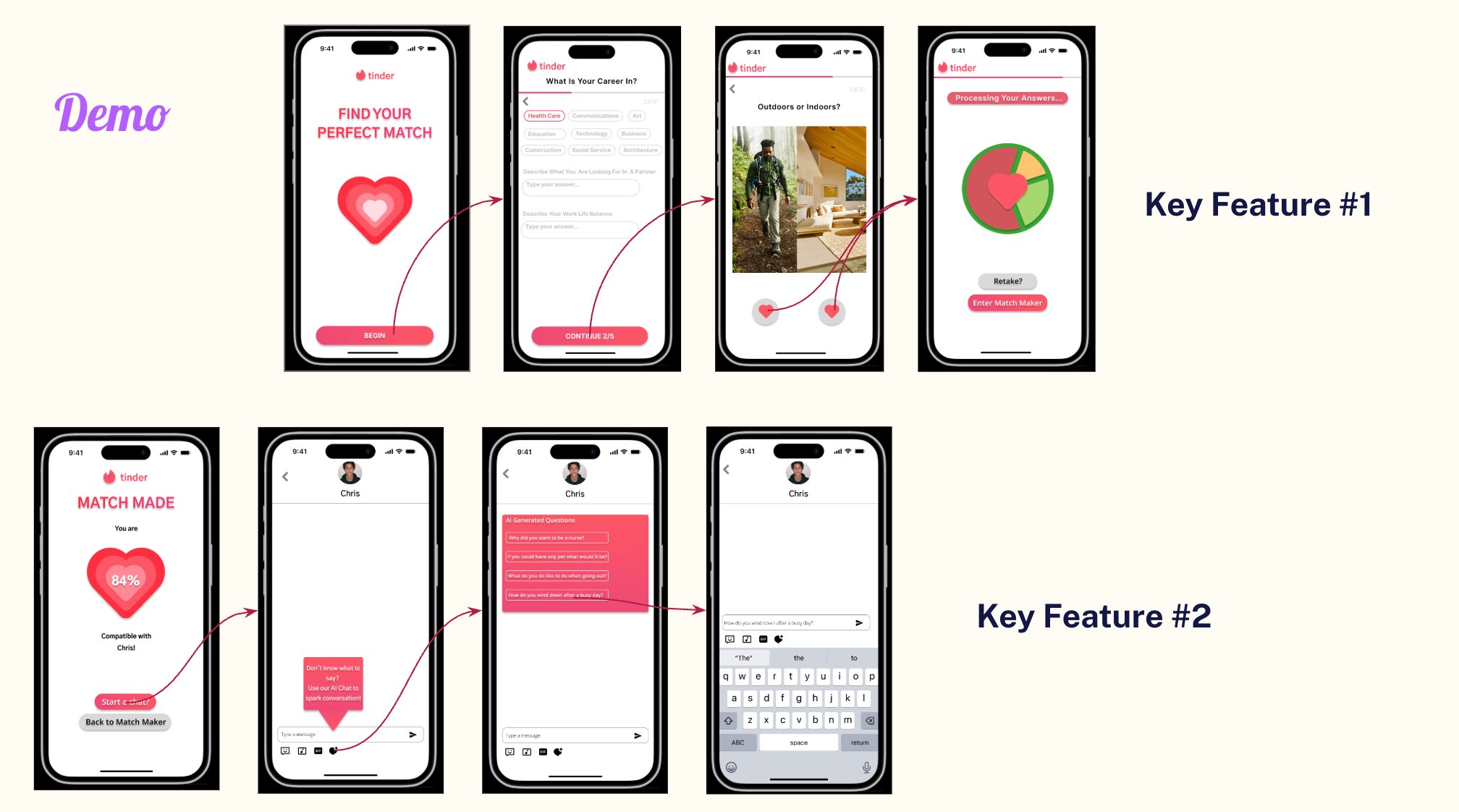
The final prototype included a compatibility quiz
that recommends people based on similar answers across career,
lifestyle, and personality dimensions. The feature also
implemented Artificial Intelligence to help new
matches find interesting and unique topics to spark a conversation —
so the moment after a match isn't a blank screen, it's an opening.
Fig. 01 · Full demo · Key features 1 & 2
Top row: the compatibility quiz onboarding flow (Key Feature № 1).
Bottom row: the match screen with AI-generated conversation prompts (Key Feature № 2).
§ Skills demonstrated
User ResearchUser InterviewsAffinity MappingFigmaLow & High-Fi PrototypingUX DesignAI-Assisted DesignGroup Collaboration
Case Study № 03Product Design + HCI Research · Figma · 2026Solo · M.I. Year 1
A calmer way to start something new.
HobbyHub is a low-intensity discovery platform for people who want to
try a new hobby — without the overwhelm of bottomless feeds, social
metrics, and algorithmic noise.
Project
HobbyHub
Context
M.I. Year 1 · Solo project
Audience
Beginners & advanced hobbyists
Method
Design Thinking — Empathize, Define, Ideate, Prototype, Test
Tools
Figma · Usability Testing · Affinity Mapping
Year
2026
HobbyHub is a platform where users can discover diverse hobbies. The
project began with a research finding I kept hearing over and over:
people who want to explore new hobbies on TikTok or YouTube
frequently feel overwhelmed rather than inspired.
They get bombarded with a wide range of videos, the recommendations
don't match their actual skill level, and they walk away more
paralyzed than when they started.
HobbyHub aims to be a low-intensity application
where users can find short, curated videos that help them explore
new hobbies they might have hesitated to try because they didn't
know where to start. It's designed for both beginners taking a
first attempt and advanced hobbyists looking for their next thing.
§
The HCI & Design Thinking Process
Five phases · empathize → test
01
Empathize
Users who want to explore new hobbies often feel overwhelmed by
excessive content, notifications, and irrelevant recommendations
on existing platforms. Instead of feeling inspired, they
experience decision fatigue and distraction —
making it harder to commit to or even start a hobby.
02
Define
Users need a focused, low-noise environment that helps them
discover and explore hobbies without being overstimulated by
unrelated or excessive content. The problem isn't a lack of
options — it's too many unstructured options
competing for attention.
03
Ideate
Concepts considered for the platform:
A "calm mode" interface with minimal content shown at once
Personalized hobby recommendations based on mood, time available, and skill level
Step-by-step "starter paths" instead of endless scrolling
Filters like "5-minute hobbies,""low-cost," or "beginner-friendly"
A guided discovery flow — quiz or onboarding — instead of a busy feed
Option to hide social metrics (likes / views) to reduce pressure
A "one hobby at a time" exploration mode to limit overload
04
Prototype
A low-fidelity wireframe in Figma was built around four core surfaces:
A simple onboarding quiz (interests, time, goals)
A clean home screen showing 1–3 curated hobby suggestions max
A hobby detail page with structured steps — intro → materials → first task
A toggle for "Calm Mode" that removes distractions: no ads, limited visuals
05
Test
Usability testing was structured around 5–8 users, with focused tasks like "find a hobby you'd try this week."
Quantitative measures
Time to choose a hobby
User-reported overwhelm — before vs. after
Ease of navigation
Qualitative prompts
"Did this feel less overwhelming than other apps?"
"What confused or distracted you?"
Findings fed directly back into iteration — refining choices that
still felt heavy, clarifying step instructions, and tightening the
starter paths for users who got stuck mid-flow.
Case Study № 01Product Management · Business Analysis · 2026Milos Automation, Inc. · PM Intern
Turning ops brainstorms into decision-ready backlog.
AuditGenius is a mortgage loan audit platform used by Credit and Compliance
auditors to review loan files against configurable checklists. I drove
requirements and backlog development for a UI Makeover initiative —
translating operations-team brainstorms into groomed user stories,
tradeoff analyses, and Jira-ready tickets.
The work spans end-to-end business analysis: eliciting requirements,
structuring competing design options for decision-making, and managing
open questions through backlog grooming. In parallel, I analyzed a
large set of automation candidates on BotGenius, classifying viable
bots for immediate API migration and pinpointing several
high-leverage integrations to accelerate the RPA-to-API transition.
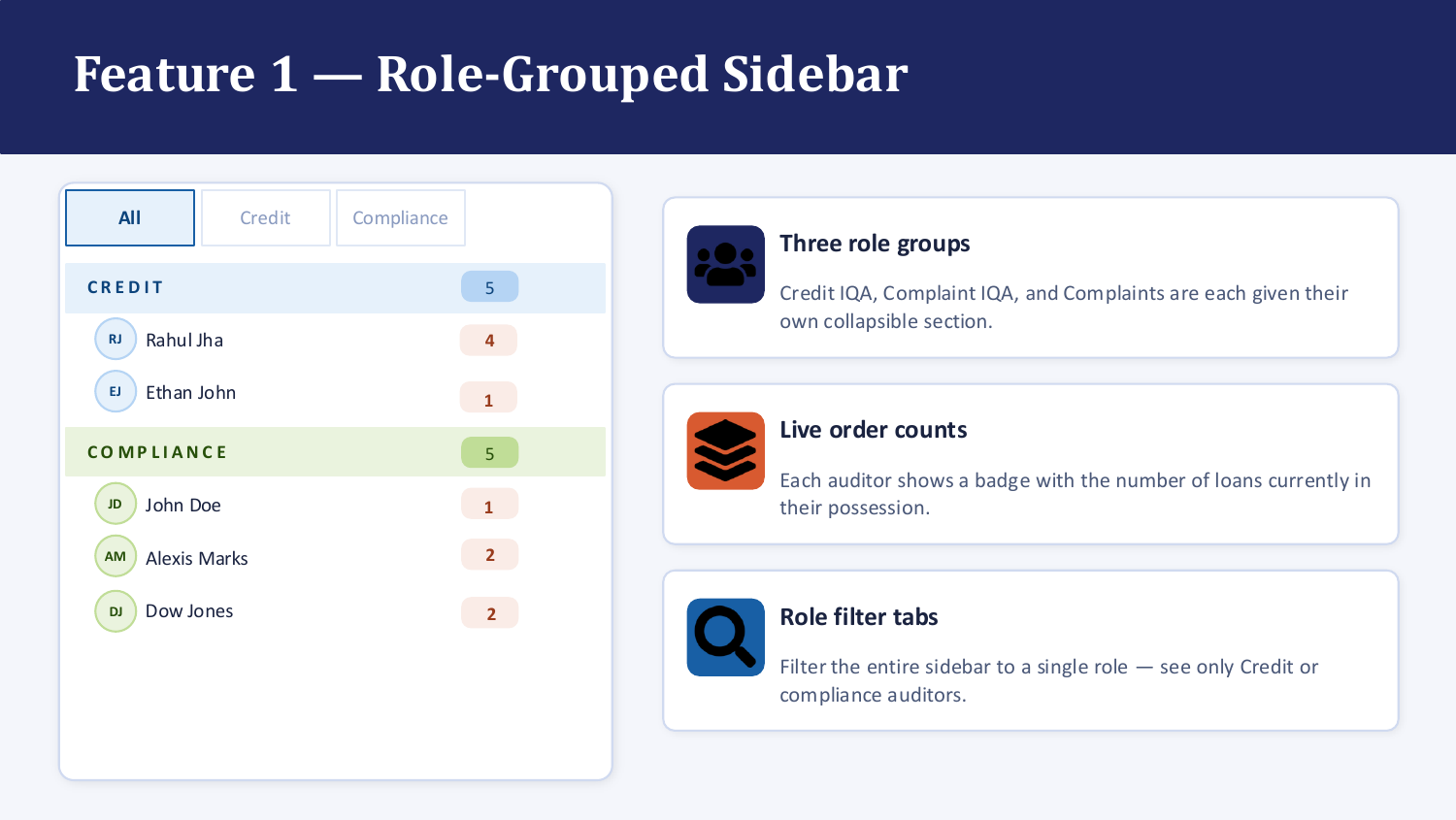
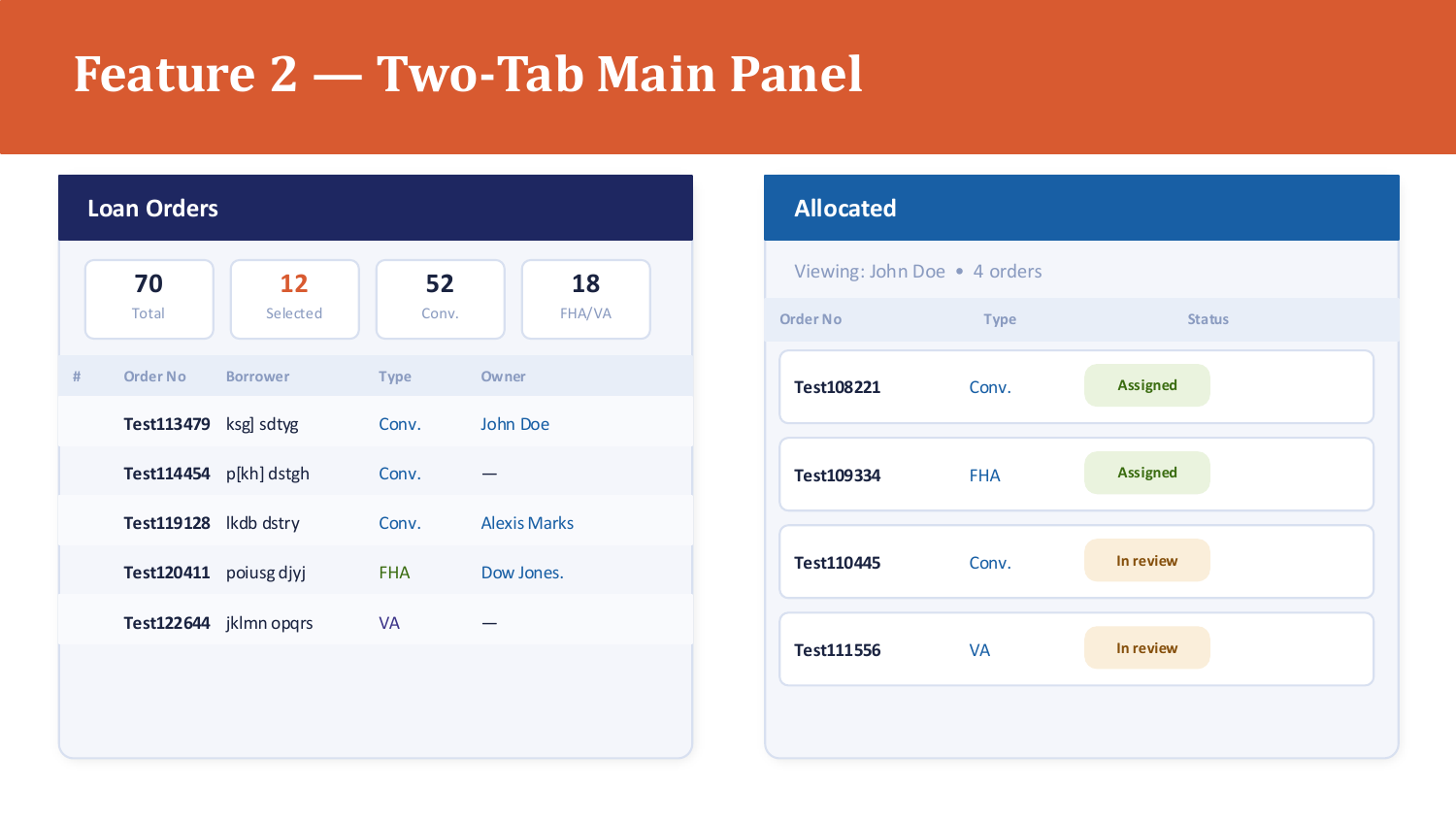
Fig. 01 · Side project · Audit Allocation Platform redesign
A parallel side project: redesigning the loan-order allocation UI so
Credit and Compliance auditors could see and manage their workload at a glance.
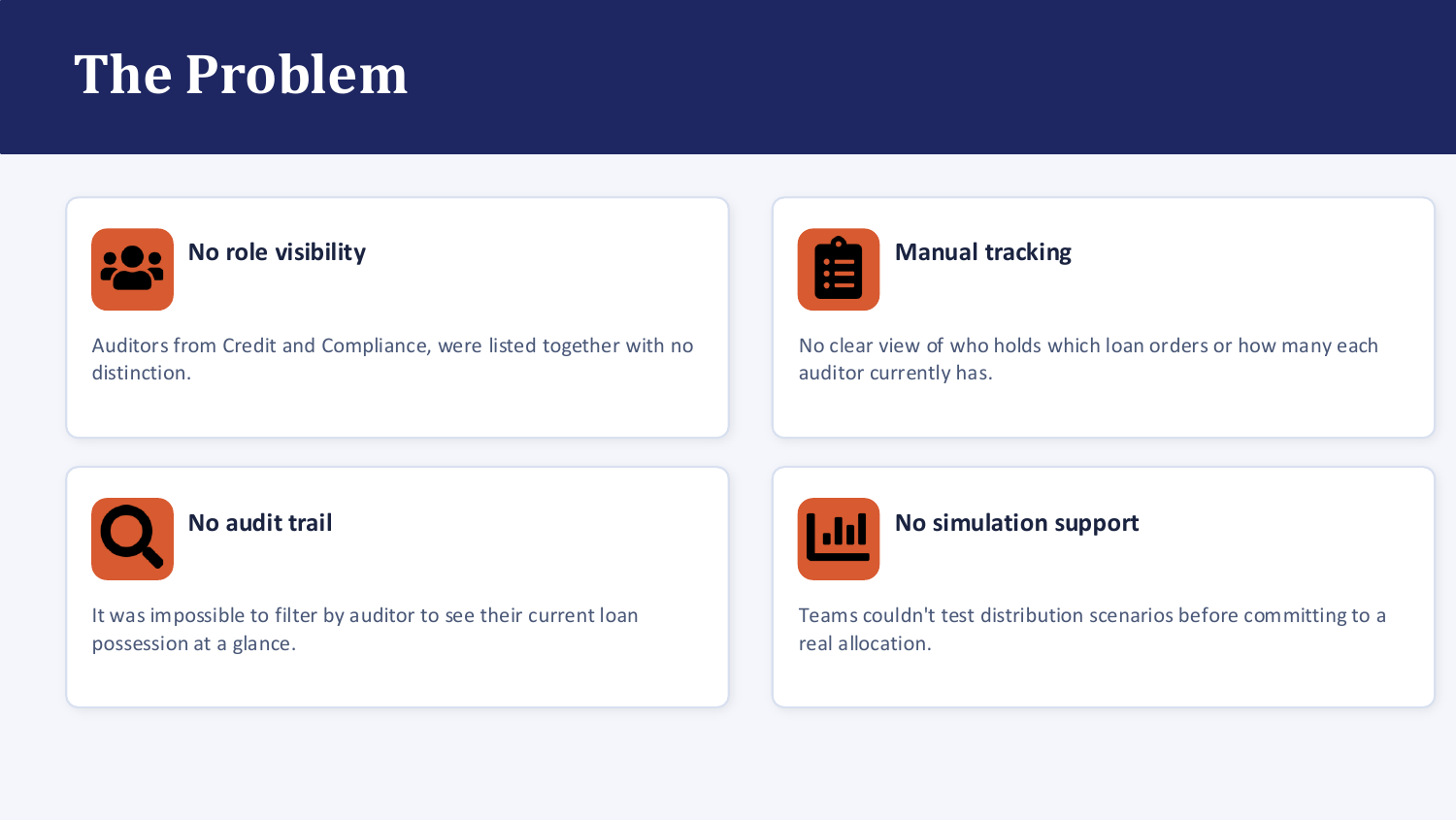
The problem: Credit and Compliance auditors were listed
together with no distinction, there was no way to see who held which
loan orders, and teams couldn't simulate a distribution before committing to it.
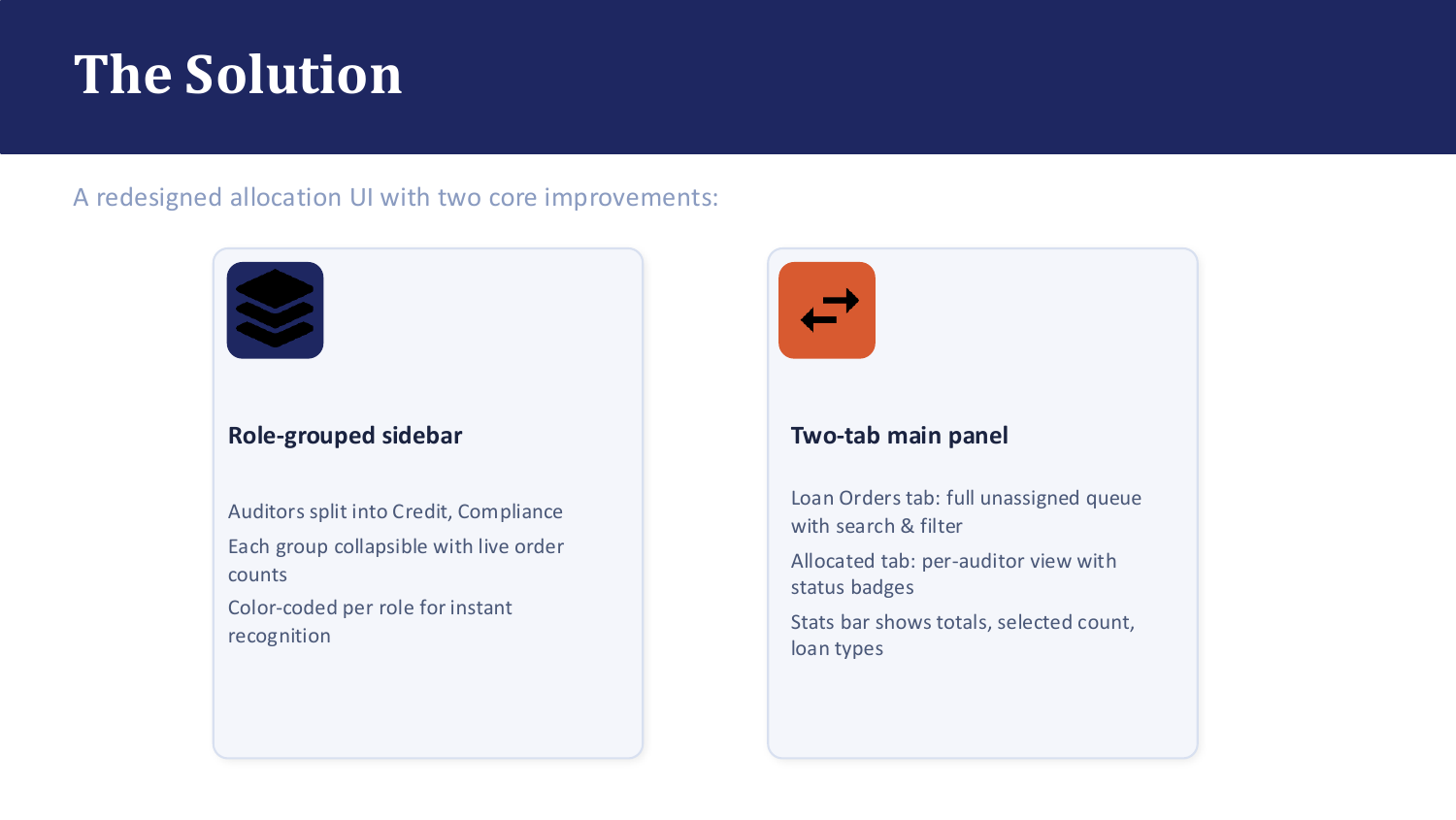
The solution: a role-grouped sidebar for auditors, and a
two-tab panel splitting the unassigned queue from each auditor's current allocation.
Auditors are grouped by role with live order-count badges and a
filter to view a single team at a glance.
The Loan Orders tab shows the full unassigned queue with search &
filter; the Allocated tab shows each auditor's orders with status badges.
When a loan needed both a Credit and Compliance audit, stakeholders
were split between two competing designs. I wrote both as parallel
user stories with full acceptance criteria and a side-by-side
tradeoff matrix, then isolated the "must resolve first" decisions
(loan-release rules, lock-contention model) blocking each path.
02
Adaptive Checklist Filtering
Auditors were answering questions that didn't apply to the loan in
front of them. I scoped the story to extend existing filtering logic
rather than rebuild it, wrote acceptance criteria for edge cases like
missing data and hidden questions, and produced a Jira-ready story
with dependencies and open questions assigned to Ops.
03
Loan Information Panel Pop-Out
The loan "More Info" panel competed for screen space with the
checklist. I defined requirements for a pop-out panel — launch
control, true window dragging, live data sync — and anticipated
multi-window edge cases plus a compliance constraint that panel
content must not be printable or savable.
§
Internship Timeline
June – July 2026
01
Onboarding · Weeks of 6/1 – 6/19
Ramped up on the platform and Jira through shadowing, training, and
feedback sessions with the team — including epics/stories/tasks/bugs
structure, sprint-sized story breakdown, and writing testable
acceptance criteria — while reviewing a competitor platform for context.
02
First Stories · Weeks of 6/22 – 7/3
Drafted the first Blended Model checklist user stories and revised
them from manager feedback, built an AuditGenius UI mockup
(documented as both a doc and a slide deck), started the BotGenius
bot-by-bot migration review, and picked up a new allocation-queue
enhancement work item.
03
Deepening the Redesign · Week of 7/6 – 7/11
Split the reverification/checklist redesign into two focused
stories — a configurable reverification pick list and expanded
adaptive filtering — and pushed the BotGenius migration analysis
(process, API feasibility, effort, and architecture per bot)
through the large majority of the bot portfolio.
04
Cross-Team Sync · Week of 7/13 – 7/23
Reworked the shared loan-data-fields story for simultaneous Credit
and Compliance audits, resolving the core architecture question in
favor of one data model with two checklist views, then drafted the
grooming document for adaptive checklist filtering.
05
Into the Backlog · Week of 7/27 – 7/30
Finalized the "More Info" pop-out panel story and a second,
competing-design checklist story, and moved both into Jira for
cross-team review — bringing AuditGenius, BotGenius, and the
Blended Model redesign toward clearer implementation plans.